
Foundational Document leading me to build FatherForm. Posted on the original (since improved) FatherForm.com in October, 2025. Written by G. Ryan Ansin
Hello World!
Thank you for your attention in this precise moment. Now that I have you, please do your best to commit to staying focused to the end of this note. Your life could change if you do, even if you don’t engage with FatherForm. This is a message about reclaiming your attention — and your time — for what matters most: family, presence, and community.
The Noise Around Us
If your experience is anything like mine, you have at least four categories of content across no less than three modes of communication, arriving in your awareness by three or more devices.
| Source/Subject | Incoming Form | Chirping Device |
| Family | Phone | |
| Friends | Text Message | Laptop |
| Profession | Phone calls/Voicemail | Watch |
| Personal Growth | Social Media | Tablet |
At each occasion for information to bombard our own thinking, if we let it, it will.
This deluge has forced behavioral evolution that I believe we will revolt against once we internalize some math. Here’s some:
Present day, fathers engage for three times more time with their children compared to 1960. That’s directionally exciting. The total, averaged across ages before high school, however, is eight-hours per week.
Meanwhile, the average adult, depending on socioeconomic factors, spends between two-four hours per day – 14 to 28 hour per week – on social media or bottomless scrolling apps (BSAs) that do not directly impact their professional pursuits. Similarly disturbing, the average adult spends one hour socializing for every seven hours watching television.
Yet, “85% of fathers said that parenting is the most (24%) or one of the most (61%) important aspects of who they are as a person.”
I’m far from the only person making these connections. In each vertical of personal growth and development, there are actual experts, which I am not, who present you information similar to the data above. The challenge is that these domain experts 1) are siloed; 2) feed the same forms information: text, audio, video – whilst our cups runneth over; 3) fail to distill suggestions to a form our brains can engage for productive behavioral upgrades. They are part of a cohort who publishes the average 15,000 self-help books annually[1]. I’m quite certain there are not 15 good new ideas annually. If there were, 28,560 great ideas would be available since Marcus Auralius was born. “Yet the same timeless truths persist.”
These Experts (actual or self-proclaimed) exist in droves. The good ones have an incredible formula for making money and displaying their thoughtfulness. In many circumstances, they are indeed great, thoughtful individuals. But the system has not been constructed for you, the consumer, to benefit from the brilliance which consumes your time.
Retention Illusion
Imagine this: You approach a breakfast buffet with every food you could ever imagine yourself eating – with 100x the proportion of what you could eat. Your eyes and stomach align intention and set a plan. With your plate full [inbox, schedule, mindshare], you begin leaving the buffet. Suddenly, a new offering appears on the overabundant table. We cannot to indulge any further. We may well eat it, but we are so far past satiation already that the incremental weighting any new offering could have is diluted by all we are consuming.
This is where we are in the information age, and AI slop exacerbates the issue.
Historically studied, we retain about 10-20% of what we read in a book, though that decreases 90% after a month. This drops dramatically as content degrades from analogistic healthy food to fast food, broken into attention-grabbing candy.
A quick conversation with ChatGPT on the matter and outcomes of this “use” of time becomes bleak. (Applicable bibliography below.)
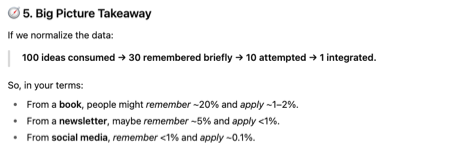
We know the content is algorithmically directed to oneself but poorly designed for our life advancement. We trust content creators we choose to follow have our best interest at heart. But, if we retain roughly 1% of what we consume, we must know we are simply wasting the hours – into days, months, even years – of our lives.
Fatherhood at a Crosshairs
Applied to the subject matter of Fatherhood, I invite you to feel the dichotomy of how we spend our time compared to how we could. Dare I say, given the state of children’s depression, anxiety, and overmedication today, how we shouldact.
It is my honor to have birthed[2] this series of technologies which aims to return one group of people control of their priorities first: Fathers. While the tools are applicable to all men and women, fathers are in a particularly unique societal position at this moment.
Data plus my own experience of deciding to be, and ultimately becoming, a father, I believe we are undergoing a societal revolution that is basically positive: Men are now involved in raising children. Reems of data show why this is positive and what occurs when fathers are absent from the child-rearing experience. Positive, thank God, as this evolution is, Men have not experienced a dramatic increase in training on the matter. Our lives and workplaces have not bent to the new reality. Our cross-generational, cross-gender, cross-functional communication strategy does not magically improve in the delivery room.
Men feel they are expected to:
1) Work fewer hours
2) Make more money
3) Learn rapid fire new skills and access new emotions
4) Be everything, everywhere, to everyone
5) Be unilaterally happy, fulfilled, and malleable in the face of these expectations.
Systematic Loneliness
As we touched on above, society is undergoing a loneliness epidemic so dramatic that in 2023 the Surgeon General of the United States had to release warnings on their detrimental effects. This includes the long-term impact of the COVID-19 pandemic, but the rate of decline in social engagement was “not eclipsed” by it[3].
In our siloed vortices, we have been shaped to prioritize individuality and self-reliance by our society and are realizing this strategy, in excess, is wrong. We are relative beings. We reflect what is shown to us.
Left unchecked, we repeat the patterns and habits of our upbringings unto our children[4]. Children’s responses and reactions to us are relative to the love, care, attention, and treatment we offer them[5]. Yet, they – the individual – often get eventually treated as the problem or the challenge to be solved, often either with individual therapy or medication. While medication is catalytic at times, I believe we have gone way too far, overmedicating personalities and individuality out of our children, and it is having dramatic tertiary impacts.
Alternatively, if we can observe families – and our own position inside of them – as systems and our children’s expressions as reflections of that system, we maintain, cater to, develop, love a family you will be proud to look back on across the decades.
The Birth of Fatherform
For those reasons, I built FatherForm for Fathers, but should the experiment prove effective and sustainable, I’d expect the aperture to expand over time either through rebranding or white labeling.
What I found as a user while building it, one interconnected tool at a time, was that increasing our level of intentionality toward our families, first, and communities interwoven closely thereafter does not require much time. I am not, Not, NOT asking you to replace your current social media with this as an alternative.By proactively building communication, personal accountability, repair, and visualization systems, we in fact save time (and perhaps money spent on extensive future therapy). Families preserve both gross hours, but more importantly positivity and closeness across life’s ever-evolving chapters.
On a shorter-term horizon, I hypothesize that if a user engages with this tool for 20-30 minutes per week, we can work toward rescuing back the residual 13.5 – 27.5 hours adults currently waste[6]. We can reallocate those non-professional work hours back to our family and friends in ways that delight them. We can grow ourselves, learn from the extended time we get to spend with those we love and show up fully, for moments that would have been lost to the ether or shadowed by a phone in our palm.
I will dance more freely, ridiculously, joyously for every person this platform helps reclaim days of presence from mere minutes of reflection.
The Goods
95% of what it takes to be an engaged father and community member is in you already. It’s my privilege to help structure information and data in a manner that reflects your goals, needs, and unique life circumstances. This level of integrated technology and personalization has never been amassed in this form (not to say it’s perfect yet). Only now, with layers of AI, can you be made aware of the intersections that define your experiences, health factors, goals, dreams, and blind spots.
Awareness brings opportunity.
We have the time.
Presence generates joy. Joy begets more presence.
Showing up for our people more fully will change your life.
| Multi-Generational Family Visualization | Dunbar Number Community Visualization and Reminders | Smart Journal Generating Personalized Reminders and Action Plan |
| Personalized Timeline with Developmental Milestones, Learning Tools, Parenting Growth/Fun Hacks | Important Date Reminder, Outreach Facilitator | Local and Remote Interview Platform to Identify Goals, Children’s Growth, and Video Notes |
| Gift Idea Tracker | Inter-Nodal Action Recommendations and Influence Tracking | Personalized Products, Tools, Service Suggestions (& Eventual Discounts) |
The Money Part
I’m proud of this aspect of FatherForm and honored to grow differently than most SaaS products or consumer offerings. Thanks to AI app development and globalization providing access to a wonderful developer who deserved every penny of his earnings, Hassan, I’ve proven a system like this can change lives on a reasonable budget.
This will become sustainable via three revenue streams:
1. Subscription revenue to cover compute costs
2. Affiliate marketing fees for products and services discovered within the app
3. Shared discounts with better-for-you, better-for-family brands who reward users for showing up for family and growth.
I’m most excited about #3. Imagine if Duolingo offered 15% off a flight to France — what a nice boost to their streak incentive program. FatherForm knows, for example, approximately when your child will naturally evolve from a car seat to a booster seat. Eventually, we’ll integrate both new and second-hand options, across socioeconomic ranges. As I type this, my children are flexing their ~150th hour in a cardboard home they built with their amazing mother. It’s not the stuff that makes parents or children. It’s the construction, the imagination, the story, the memory. The Time.
Any commercialism presented on the app must be highly defensible, of utmost integrity, and offered with transparency.
In early October 2025, I remain undecided if this will ultimately launch fully as a C-corp, LLC, B-Corp, or 501(c)3. I’m exploring all options, but focusing primarily on building. Structure will come as valuable partners emerge to co-create the very best product for families.
A Personal Reckoning and Victory
Finally, I want to share a major victory that came from using FatherForm:
Early Win:
A father of two and a time-chaser, I am in a constant state of conflict. I care deeply for my kids’ futures, so I demand of myself that I create value — income to support them, to build a secure platform for their lives. Yet the more time I spend building on their behalf, the less time and energy I have available to them in these early years. It’s a constant balancing act.
One critical growth area over the course fatherhood was transitioning off high-dose sleep aids to be present and available during any emergencies. More meaningfully, I yearned to sleep under the stars with my kids. Seems tiny, yet a long trail to traverse across years of progress, unwinding decades of poor sleeping habits. Before children, I transitioned from pharmaceuticals to medical cannabis. Early in our first child’s life, with my dear friends support – via intentional group trips and inner explorations, I eliminated cannabis all together. Now, with a half-dose of melatonin, I am a happy snoozing bear – but instantly available as our brains naturally allow.
A few weeks before launching FatherForm’s beta, we pitched a tent as a family and one of my children made the night. We expect all four of us by next spring! This reversion to what’s natural – sleeping under the stars with the sounds of wind and crickets driving my dreams – was only possible using the tools now in FatherForm. The final key – the tent itself – was a direct gift from the app at the intersection of Snapshots (listening to my child’s desire for sleepovers), Gift Tracker (adding over time life-expanding offerings instead of reactive “stuff”), and Family Nodes (witnessing my mother’s love for her grandchild to experience nature and acting on it).
Conclusion
I recognize that FatherForm is not for everyone. It’s imperfect. It requires more integration — and at times, it feels like work.
VCs seasoned in go-to-market strategy often worry about products that grow slowly. My feeling is twofold: (1) I’m not worried about an immediate J-curve, so long as costs are covered. The goal is changing the landscape for children who did not ask to be brought into this world. (2) The bell curve of adults in 2025 has self-admitted poor technology hygiene, where behavioral economists working for media companies have captured their minds and time. That time is available for reallocation — both to assess and to enact the change we desire.
After all, while the 15,000 self-help books published annually would love you to think there are endless new ideas, our fundamental experience of life has not changed for thousands of years. It still comes down to this:
“The unexamined life is not worth living.” — Socrates
I hope you find as much joy in the examination, contemplation, and rejuvenation made possible by interconnected tools as I do. We have the chance to delight.
— Ryan Ansin
[1] https://www.washingtonpost.com/books/2025/01/10/self-help-books-new-year/
[2] I ache with imposter syndrome having built this thing. I can’t code a lightbulb. Replit + other tools have allowed a layman, explicitly not an expert in anything, to create this platform on which true experts – informational contributors and fathers themselves – can interact seamlessly.
[3] https://www.sciencedirect.com/science/article/pii/S235282732200310X
[4] Two books intersect here and are critically important if you take nothing else from this and are uninterested in FatherForm: Us by Terry Real, and Parenting from the Inside Out by Dr. Daniel Seigel
[5] Most recent, great, book here is Dr. Becky’s Good Inside – and her supporting app. Both magical.
[6] I’m comfortable saying waste here because of our current information retention and activation strategies yielding sub-1% efficacy across media forms.