How Fundamental Curiosity can change your life. By Ryan Ansin
My late grandfather, Ron Ansin, Gd bless his soul, offered welcoming hints on how to live life to those lucky enough to spend time entwined with his profound interest in human and societal wellbeing. “Always take the first meeting,” he would say about anyone who reaches out with good questions. More meaningfully, “Know a little about a lot and a lot about a little.”
This second maxim has guided my life. I have cared to know how everything interacts, therefore I must be aware of many things. Secondarily, I love Aldous Huxley’s belief “The more a man knows about individual objects, the more he knows about God.” Meaning, by deeply understanding the microscopic, we will learn much about the whole.
I’ve been chasing that habit of curiosity as a lifestyle ever since digesting Ron Ansin’s advice. I call it “the most curious seat”: the chair where you ask more than you answer, and see what people hand you once they become comfortable that you actually care to know.
As a young child, I detested the question, “How are you?” because I was in a constant state of pain and I did not believe that most people asking wanted the truth.
My theory is a simple one, and I’ve tested it against friends and family across every income bracket and zip code: the person who sits in the most curious seat learns the most and develops the deepest relationships. Bank balance or formal education level have never been the deciding factors.
Shunryu Suzuki wrote that in the beginner’s mind there are many possibilities, but in the expert’s mind there are few. Most of us stop asking real questions of the people we love earliest, not latest, because we mistake years of proximity for understanding. We assume we already know our spouse’s answer, our teenager’s mood, our old friend’s real reason for calling. Expertise closes the exact door curiosity keeps open.
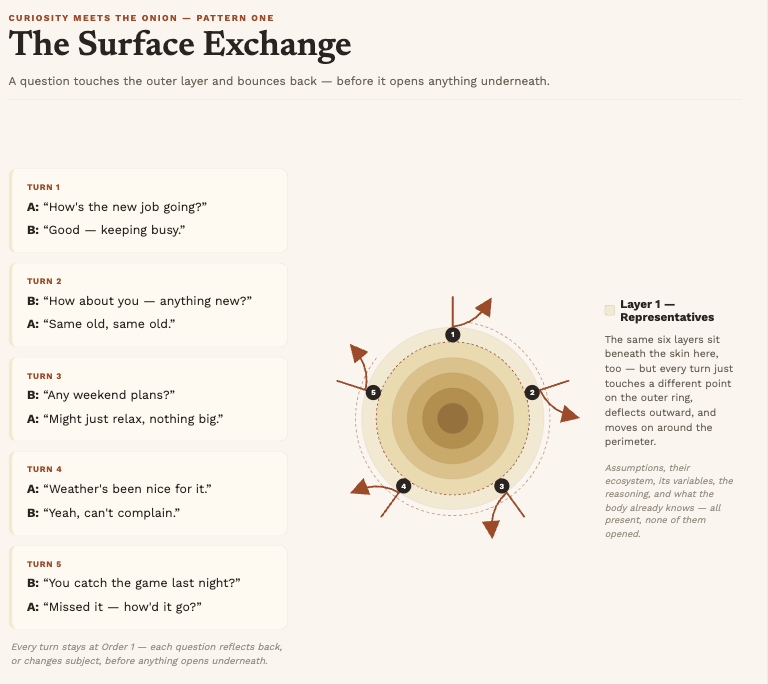
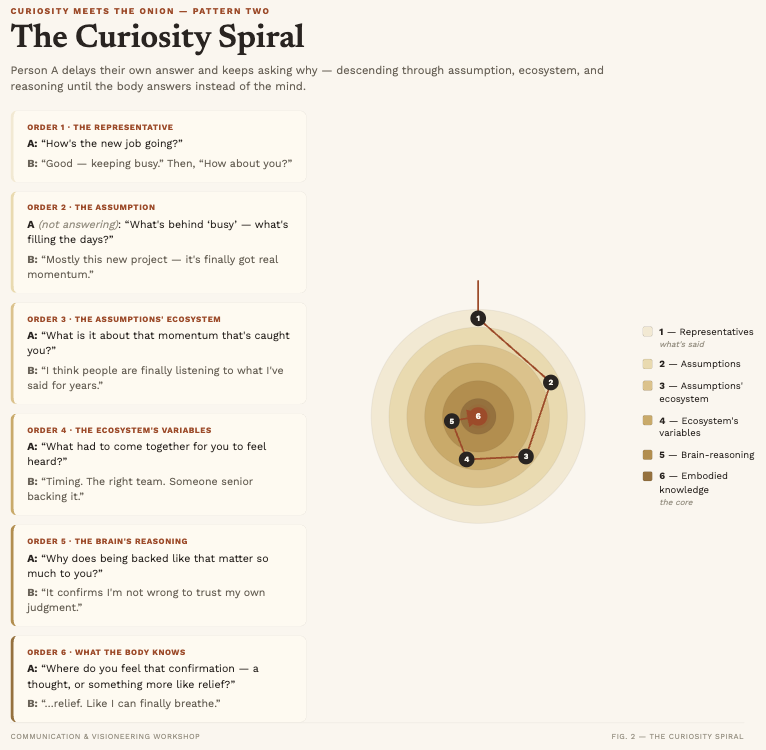
With any of these counterparties, we must be aware of the difference between conversation on the circumference of an issue as opposed to the depth, and our own responsibility to travel to the core. To do so, we must refrain from offering our own insights too early. This can be five or more guiding questions, or simple (and via loving expression) why repetition.
Lao Tzu made the same point about geography twenty-five centuries earlier. The sea is king of a hundred streams, he wrote, because it lies below them. It doesn’t summon the water. It simply occupies the lowest point, and everything flows toward it on its own. Put yourself at the bottom of the informational valley in a conversation, ask instead of tell, and the same thing happens. People send their real thoughts downhill toward whoever is willing to receive them without judgment. Very few of us make ourselves that low on purpose.
I’ve written before about Return on Invested Time: the discipline of measuring moments instead of hours and the rewarding results within families. Not just whether the visit went fine. Compounding Interests, the ideas and activities that grow out from the seeds of a moment, treats curiosity itself as the asset. The interests people carry, in themselves and between each other, compound if someone bothers to invest awareness into them, revisit them, ask what’s changed. Left untended, they don’t sit still. They vaporize into thin air.
None of this is soft. Robert Waldinger, who directed Harvard’s nearly 100-year study of adult development, put it as plainly as a Zen Priest researcher could: “Good relationships keep us happier and healthier. Period.” 53-million TED Talk views can’t be wrong. The people most satisfied in their relationships at fifty, his data shows, were the healthiest at eighty. Not the wealthiest. Not the most accomplished. The most connected.
This holds true in our new friendships and within business, and even more so in our familial and love relationships. People receive love differently, most can’t articulate how, and the only way to find out is to ask more questions than you answer. Gary Chapman’s Five Love Languages offers guidance to this end. When we date or court each other, we discover, learn, and reflect the other’s love language. When we marry, we slowly expect our spouse to speak our own, forgetting to rediscover the evolution and undulations of theirs. Curiosity isn’t lukewarm expression that obfuscates a question. It’s a significant tool for finding the specific door into someone else’s specific heart. I enjoy learning my friends’ love languages as much as acting on the discovery of my wife. Doing just a little extra, in response to discoveries through curiosity, as a host, a gift-giver, in letter-writing, stands out to receivers dramatically because most people operate at a very thin level recently. They haven’t protected the energy to perform otherwise.
Where Curiosity Gets Tested
It’s easy to be playfully curious when the sun shines, bellies are fed, hormones are in balance. Check how we do with curiosity during a fight? Conflict is where most of us abandon curiosity entirely. We defend, we explain, we hardly wait for our turn to talk, often speaking from reaction instead of digestion and interpretation. The instinct is to treat friction as something radiating outward, a fire to survive or extinguish.
Try treating it as new footing. This is very uncomfortable as you must abandon hope of convincing the other that they’re wrong – even when they absolutely are. Attempting curiosity may also create explosions. You must breathe through it with love – and often professional guidance. Good friction is where we find footing and handholds on a rock-climbing wall for further ascent. Asking with real curiosity and no embedded agenda, where the pain emanates. That single pause, taken at the most difficult moment is the practice in its hardest form. The lack of attachment to a personal agenda is critical. A friend of mine recently quoted Coach Nick Saban’s distinction that leadership is to the benefit of others, while manipulation prioritizes your own. We must be curious on behalf of others and the space between us we’ve both opted into.
If you can stay curious in the middle of a fight, staying curious at the dinner table stops being a discipline at all. It becomes the most natural way to sit with the people you love. The most curious seat in the room was never about being interesting. Focus on being interested, at the most challenging moments as readily as the best ones, until that’s simply who you are.