How to inspire curiosity through the labels on your clothes. By Ryan Ansin
“The more a man knows about individual objects, the more he knows about God.” — Aldous Huxley, Island
There are 11 buttons on the shirt I’m wearing. When I button them, I wonder who sewed them on. I asked my nephew about who sewed his buttons and he looked at me like I was crazy.
With a career starting in film in Southeast Asia, supply chains have been closely on my mind for most of my life. I care to share this to spark curiosity through families and across ages. Not in a guilty way. Guilt teaches us to avoid the opportunity to learn, especially with children who didn’t ask for the downsides of globalization, which has indeed brought us so much. I mean it in the way Huxley meant it in Island: that if you look closely enough at any ordinary object, it opens like a door, and on the other side is the whole world.
People must be clothed and the vast machinery that clothes billions is one of the more astonishing things our species has ever built. This is an invitation for you, and especially for your kids, to treat the closet as one of the most interesting classrooms in your house. The label isn’t an indictment. It’s a passport.
A Global Exploration
Pull one thread and see where it goes.
The cotton in a single t-shirt was likely grown in one of the roughly eighty countries that farm it, tended by some of the twenty-five million people who grow it worldwide. From there it was probably spun in one country, knit and dyed in another, cut and sewn in a third, and printed or finished in a fourth. By the time it reached you, that shirt may have traveled more than twenty thousand miles. The “Made in ___” on the label names only the last stop on a very long road.
The plain shirt in the drawer is one of the most well-traveled objects we own and showing kids the various origin points on a wall-sized map opens a lot of minds.
Try it. Read a label together, then look up the brand to see how much they’ll actually tell you about where and by whom it was made. Some brands have decided to open the whole thing up. Patagonia put its real factories and mills on a public map years ago, on a simple bet: that when one company shows it can reduce a harm, others will want to follow. And they did follow. Founder Yvon Chouinard once stood in front of more than a thousand of Walmart’s buyers to talk about vetting suppliers, and the seed of that work didn’t die; it grew into a shared industry effort and the measurement tools that a lot of big companies now use to grade themselves.
It’s easy to make companies out to be villains, but this isn’t journalistic work, and I don’t find it productive to expose evils — even to the companies themselves. I believe the biggest companies are the ones with the power to change the industry. Small companies often prove the possibility, with incremental change to follow. Perhaps not quickly enough, but, to say the least: it’s complicated. Especially so when consumers have been trained to crave more – which is a very complex system of emptiness and society-wide implication.
Walmart clothes hundreds of millions of people who need to be clothed, and there is real greatness in that reach. H&M has begun weaving in recycled fiber from a company called Circ that can finally pull apart the blended polyester-and-cotton fabrics that used to be impossible to recycle. Newer brands like Quince are trying, in their own contested and imperfect way, to make better materials affordable — to cut out the middlemen so that “nicer and longer-lasting” doesn’t only mean “for the rich.” None of them are finished. None of us are. The whole industry moves the way most good things move: by increments, by one company caring enough to try something, and the giants slowly following.
Who Made Your Clothes — and Where to Next?
But back to the button, and the person who sewed it on.
Most of our clothes are made by people doing one small thing, thousands of times a day. Adam Smith, who practically invented the case for dividing labor this way, also warned in the same breath that a life confined to one endlessly repeated motion could dull a mind — he called it a kind of “mental mutilation.” I don’t raise that to make anyone feel bad. I raise it because the whole exercise is about putting the person back into the object. To care about the button is to care about the hands that attached it. That is the Huxley move exactly: know the small thing well enough, and something larger and more sacred looks back at you.
Then there’s the honest question I can’t resolve, and don’t want to resolve for my children. If I buy a shirt secondhand — if I’m rescuing it from a landfill or an incinerator — do I still have to care about the supply chain that made it the first time?
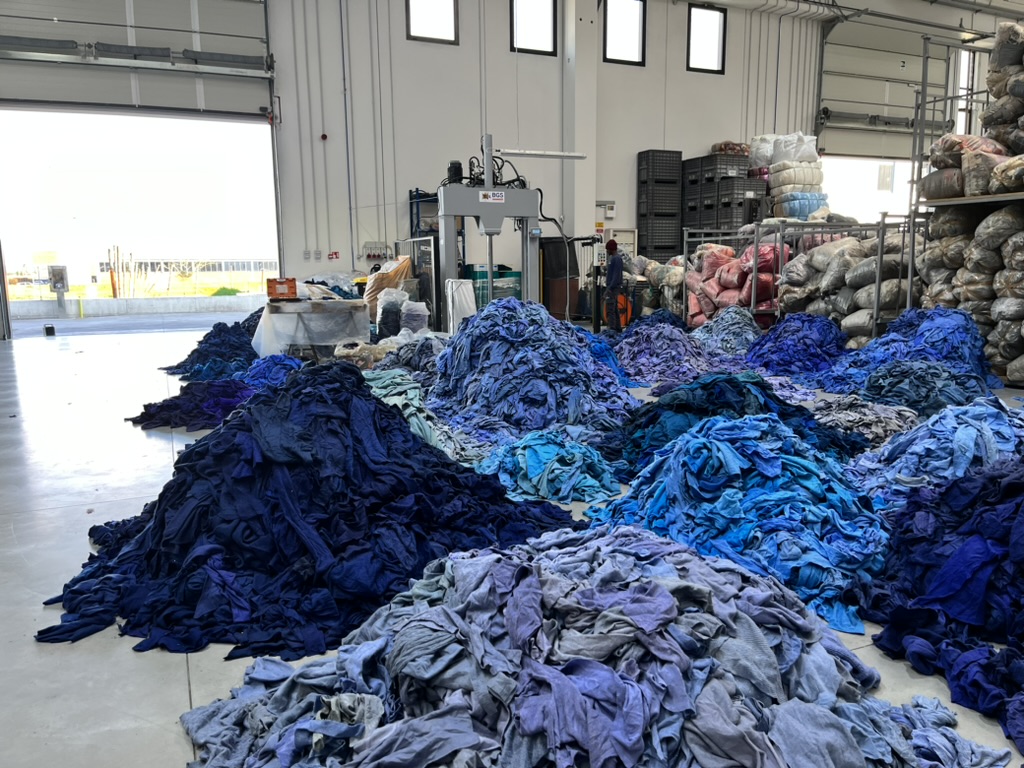
I genuinely don’t know. Look at Accra, in Ghana, where the world’s used clothing arrives by the bale. One story calls it a dumping ground, where a huge share of what comes in leaves almost immediately as waste. But the Ghanaian traders themselves push back hard: they say very little is unusable, that their trade clothes most of the country with dignity, and that the “dumping ground” narrative erases their skill and their livelihoods. Both things seem to be true at once. I’d rather sit inside that tension with my kids than pretend I’ve settled it. Meanwhile, I respect tremendously the entrepreneurs and educators like Liz Ricketts of the Or Foundation and Clarisse Merlet of FabBrick who are working to change the end of the supply chain at scale. So important.
What Will My Kids Want to Change?
In one of his TED Talks, Juan Enriquez invites us to wonder how our sense of right and wrong evolves and what future generations will think about our actions. I often wonder this about our supply chains.
Which brings me to the part that matters most.
What would a six-year-old make of the fact that some of the clothes made for children are made by children? It’s a hard thing. And the research on hard things is surprisingly clear: avoiding them doesn’t protect kids. Honest, age-appropriate conversation does evolve their thinking. Children already carry a fierce sense of fairness and the trick isn’t to unload the adult weight of the world onto them. It’s to ask what they already think, follow where they lead, and keep it at their size. As they grow into the facts, they become the ones to change the paradigm.
Let’s make it a treasure hunt, not a tribunal. Let’s read labels and count how many countries are hiding in one closet. Let’s trace a shirt’s journey across a globe. Let’s wonder, out loud and without answers, about the person who sewed the button, and say a small thank-you to them.
And once you’ve started, you can’t stop, which is the whole point. Closets are hardly the only Pandora’s Box. Break open an old, already-broken gadget on the kitchen table sometime. Inside is a tiny world: the tungsten that makes a phone buzz, the cobalt in the battery, copper wiring, a little gold at the connectors, some of it traceable to hard and faraway places. It may make your kids gasp that a ton of old circuit boards holds more gold than a ton of gold ore, which is why recovering it is called “urban mining.” Every object is a door. The more you know about any one thing — a button, a battery — the more you know about everything, and everyone.
That’s what I want to hand to our next generation. We’re not turning into monks or aiming at perfection. It’s not about our ego – it’s a curiosity so alive it can’t help but turn into love. It’s remarkable to see how quickly kids “get it” when time is taken to bring a bug outside, to turn clothes into something useful, or to start to wonder about things that are taken for granted.
It’s all sitting right there, ready to be understood and evolved.
Related reading: Where Time Meets Curiosity — on making curiosity the engine of a family’s life across generations.