How practice – imaginative, or through offering yourself observed grace – can make you a better father. By Ryan Ansin.
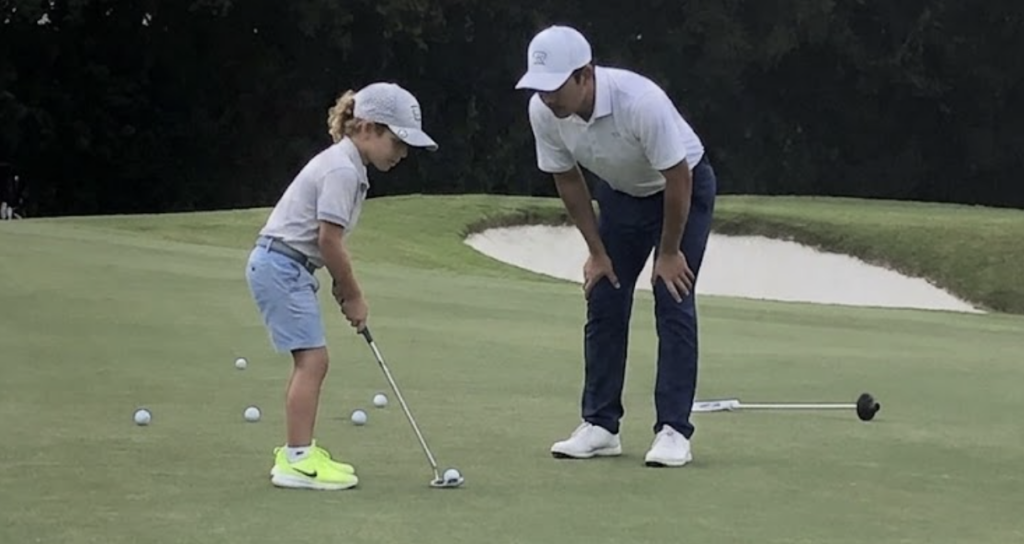
What would curiosity and practice do to your parenting game?
Every good golfer has hit ten thousand shots that built upon the last mistake.
That’s the deal golf makes with you. Before the shot that counts—the one over water, the one for the match—you get to rehearse it a thousand times where nothing is at stake. The range. The practice green. The Tuesday round with friends. Golf lets you fail in private so you can perform in public.
You train the body: the grip, the turn, the tempo. You sharpen the mind: the breath before the swing, the story you tell yourself after a bad hole. You consider shotselection: the driver, the wedge, the ugly little bump-and-run that saves par. And you train selection—reading the wind, the lie, the slope, choosing the right club for the exact moment in front of you.
By the time it matters, your body has a general sense of your ability to handle the situation, a range of likely outcomes from the attempt, and how you would handle the next challenge.
What about at home?
Now think about fatherhood.
There is no range. There is no bucket of balls at dawn. The first time your daughter looks up at you, terrified, is the first time you’ve ever done it. The meltdown in the grocery store is not a practice round. The night your son says something that cracks your heart open—you get one swing, cold, no warmup, and it counts forever. Reading the book, Let Me Hold You Longer, should rip tears from your eyes, knowing it will be gone in a flash before you learned how to make the most of it.
We train for the game. We wing the thing that actually matters.
Consider the cost of a miss. In golf, you shank it and you lose a stroke, maybe a ball, maybe fifty bucks. Painful, recoverable. There’s always the next hole. Miss in fatherhood and you don’t lose money. You leave a mark—a small crack that, left alone, gets handed down. One crack at a time. Personality changes, one by one. The result is a slightly modified person. You get to choose the quality and permanence (or elasticity) of the modification.
But here’s the mercy golf doesn’t offer: there is always the opportunity for repair. No score is final. You can walk back into the room, kneel down, and say “I got that wrong.” Your kid doesn’t need perfect. They need to watch you take an honest swing, miss, and come back with grace. Modeling the recovery might be the whole game as it shows them the real playbook. To this end, I love giving my friends bracelets whose brail says, Wabi Sabi Baby!
And the joy—this is where the comparison breaks entirely.
Golf’s joy is real, and it is bounded.
Fatherhood’s joy has no back nine. It compounds. A small moment today ripples out across a life, across generations you’ll never meet. The upside isn’t a good round. It’s your kid, decades from now, still feeling your radiating lessons in the river of time that keeps changing.
So why do we accept ten thousand practice swings for a game and zero for our children?
Practice and contemplation can be a driving range of its own kind. But no one built the space and method to inspect decisions and improve the frameworks. We have to record our swings to see and improve upon them. The feedback loop – seeing the ball fly straight – is a bit like seeing a child settle in after a scraped knee. “It’ll heal!” Seeing what they do next is like staying composed for a full round.
You can’t rehearse the exact moment. But you can train adjacent to it—the way a golfer trains on the range, not the course. One honest minute in the morning. A small razor instead of another self-help book. In Good Profit, Charles Koch quotes Harrington Emerson, “The man who grasps principals can successfully select his own methods. He who selects methods, ignoring principals, is bound to have troubles.” You practice noticing, so that when the real shot comes—unannounced, cold, high-stakes—your hands already know what to do.
The goal is not a sense of perfection. It is direction. There’s no trophy and chasing it only makes you worse. The goal is smaller and infinitely bigger: to keep learning, keep iterating, noticing, with unbound curiosity. You will meet the moment your kid needs you and you’ve practiced that shot.
Golfers train their whole lives for a shot that hardly matters.
Imagine if we trained, even a little, for the one that does.