How travel as an intentional activity has degraded into a stressful money pit. By Ryan Ansin
The travel industry has been completely bastardized.
Travel used to be the one thing that could crack a person open. You left your zip code, your defaults, your little rehearsed self behind, and something rearranged inside you. It was not meant to be easy. It was meant to be an adventure. Whether a hike, drive, or flying to a distant land, the expectation was for something new and different – on purpose.
Your perspective somewhat changed, you came home softer. Curious. More present with the people you actually love. That was the entire point of getting on the road — not the room, not the buffet, not the wristband.
So how did we turn that into a photo op with a $600 cover charge? How did the most transformative thing a human can do — go somewhere and be changed by it — become a transaction where you pay four figures to stand in a chlorinated line and eat a chicken finger the size of your forearm? We didn’t lose travel to some villain. There’s no shadowy cartel that did this to us. We did it to ourselves, little by little. The good news about a self-inflicted wound is that you can also un-inflict it.
Here’s what I’m seeing.
It costs more than ever.
This is not nostalgia for $1 gas. The numbers are insane.
By the middle of 2026, the average insured summer trip hit a record $9,032 per person — up 17.4% in a single year, according to travel-insurance marketplace Squaremouth (reporting here). Earlier in the year they pegged the average trip at $7,257 — the highest they’ve measured in 23 years of measuring, and more than $1,250 higher than a comparable trip cost from 2017 to 2020 (PR Newswire via Yahoo Finance). The U.S. Travel Association says the cost of getting away from home is running 8.1% above last year, with hotel prices 13% higher than 2019 (U.S. Travel Association). And the stuff that hammers families hardest — eating out, “entertainment” — keeps climbing even in the months everything else calms down (NerdWallet).
It gets worse. Roughly 60% of travelers now plan to borrow money for their trips — credit cards they won’t pay off, cash advances, even payday loans (NerdWallet, via Yahoo). Read that again. We are taking out loans to be miserable in a more expensive location. If a thing is supposed to restore you and you go into debt to get it, and you come back needing a vacation from your vacation — you didn’t buy a rest. You traded peace of mind for an expensive costume.
We’ve reverted to the mean of taste and experience
Most “destinations” are now the same destination in different skin.
The all-inclusive model won, and it optimized for exactly the wrong thing — keeping you inside. Same lobby. Same buffet. Same three sad “signature” cocktails. Same chicken tenders whether you’re in Cancún, Orlando, or a Caribbean island someone spent a lifetime’s savings to reach. The local spot — the one that could only exist right there, the reason to leave your house in the first place — got bulldozed by the wristband economy. You flew across an ocean to eat mozzarella sticks by a pool. Bold.
A friend of mine who runs a hotel in the British Virgin Islands told me something I can’t shake. Every year he raises his prices. Every year his occupancy stays exactly the same. The only thing that changes, year over year, is that guests spend more time in their rooms, on their phones, and less time out in the water, in the town, in the actual paradise they paid for. He is selling one of the most beautiful places on Earth, and people are using it as a backdrop for scrolling. That’s not a hotel problem. That’s a human problem.
The Orlando math
Need convincing of the bastardization in a single receipt? Take a family of four to a water park.
A one-day ticket to Universal’s Volcano Bay runs about $80–$110 for adults and $75–$105 for kids (Orlando Theme Parks; Park Prodigy). Disney’s water parks are around $74 a head; SeaWorld’s Aquatica, $45–$75 (Orlando Theme Parks). So before a single fry, a family of four is already $310 to $430 in the hole just to walk through the gate. Now add parking, tax, a locker, and lunch — and the food is where it turns into comedy: $150 for chicken fingers and Coca-Cola for four people is not a horror story, it’s a normal Tuesday. All in, $600 for one day with two kids isn’t a splurge. It’s the floor. Six hundred dollars, so your children can eat beige food in a park engineered so you never leave and never stop paying.
By the way — don’t dig into the supply chain of the chicken finger, the swag, or the health of the majestic sea creatures in a swimming pool.
We are convinced what exists is magic… as long as we suspend the intuition that our kids’ bodies and minds will be poisoned by the magician and its tricks.
The way out is cheaper, closer, and more human
I have hope.
The antidote already exists, and — thank goodness — it costs less.
Start with how normal people actually travel. Not everyone is jetting off to a lounge. More and more, families are trading one or two big flights a year for a string of shorter, drivable getaways — and the data backs the shift. 71% of Americans now plan to drive on their next vacation, and most car travelers say they prefer the road for the spontaneity it allows (Hilton 2026 trends research). The “microvacation” — one to four nights, usually within a short drive of home — has gone from niche to mainstream, with one in five Gen Z travelers planning shorter trips this year (Bank of America, via The Week). Two week-long flights become seven long weekends: possible, affordable, and a fit for remote work and a deserved breather. This market is not a consolation prize. That’s the whole opportunity — and it’s exactly why Hideaway Inns exists.
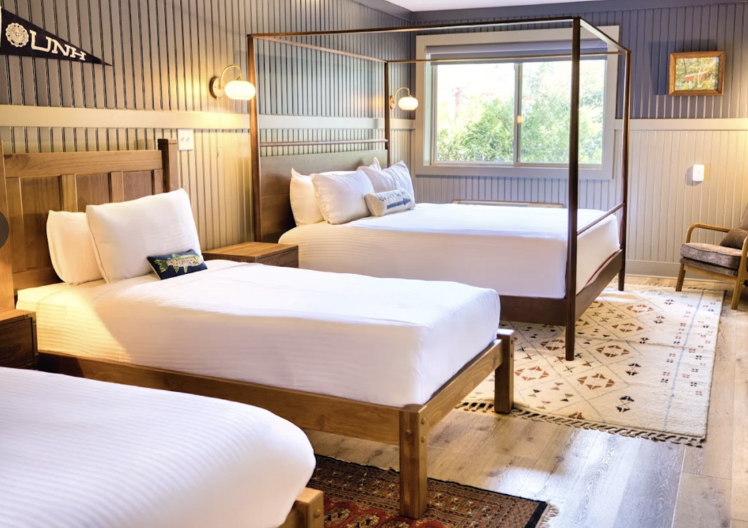
Hideaway builds beautiful, design-forward inns that are portals to nature instead of walls against it — drivable getaways where rooms typically run under $250 a night. They’re planted at the doorstep of the good stuff: Lake Sunapee (Newbury, NH), Lenox in the Berkshires, Franconia Notch (Sugar Hill, NH), Mt. Snow in Vermont, with Killington opening in November (Hideaway Inns). Their model — they call it Invisible Hospitality™ — means no front desk and no lobby purgatory; your room code lands on your phone and you walk straight in. What that actually buys you is a one-of-one experience: handcrafted rooms, record players, fire pits, a real local guide to the trails and the dinners worth your evening — the amenities you want, minus the ones designed to trap you indoors and empty your wallet. You’re not paying $600 to stand in a line. You’re paying a fraction of it to walk to a lake, two hours from Boston, and remember what quiet sounds like.
And if you can swing the airfare but refuse to hand your whole budget to a resort, look south. Bambuda in Panama has quietly cracked the code across Bocas del Toro, the mountains of Boquete, and the surf town of Santa Catalina. A certified B Corp, they offer everything from dorm beds to private and family rooms, with rooms starting around $60 a night. The genius is the range: Bambuda treats travel as a lifestyle, not a social class. The backpacker, the family, and the couple on a milestone trip all land at the same waterfront, watching the same sunset — and, as they put it themselves, letting the sunset be the screen time.
The standard we should hold travel to
So what is a trip actually for? It should restore, offer a chance to learn, to see yourself in a new frame, and connect with the people you love. Not higher stress in a prettier setting. Not a week of negative calories and wristbands and four people staring at four screens beside a pool.
A friend of mine who runs hotels and villas (prices range from less than $100 per night to thousands for ultra-lux stays) in Tuscany is chasing the most interesting version of this idea I’ve heard. He spends as much energy helping travelers carry the spirit of Tuscany home as he does on the trip itself. His goal isn’t a great week you post and forget. It’s full rejuvenation, plus small changes you keep — the slower meal, the evening walk, cheap yet amazing local olive oil and honey, the attention you started practicing there and refused to leave behind. Travel as something you ingest and adopt, not something you photograph and discard.
That’s the bar. Not “did it look good?” Not “did it get likes?” But: did it change how I live when I got home?
We bastardized travel by making it expensive, identical, passive, and performative. We take it back for ourselves and our families the same way we take anything back from a machine that does not have our best interest at heart. We do it on purpose, with our own two feet, considering first principles – not who is marketing to us the hardest. Make YOUR choice. Not theirs. Choose the lake over the line. The local table over the buffet. The sunset over the screen.
The good version of travel was never the pricier one. It was always the one where you were actually there.