By Ryan Ansin
The Buddha asked his students to repeat five facts every day. I will grow old. I will get sick. I will die. Everything I love will change and be parted from me. I keep returning to the fifth: I am the owner of my actions and “heir to my actions.”
Twenty-five centuries before anyone drafted a trust, he had named the one inheritance that survives a bad market or a bad decade. The wealth industry measures the other kind, and calls its best clients Ultra High Net Worth. I want to propose a different measure: Ultra High Net Capability. It rests on a number I call net capability. That number is hard to come by, and it exists to be exceeded.
The man who had enough
Kurt Vonnegut told the modern version in a poem. He and Joseph Heller were at a party thrown by a billionaire on Shelter Island. Vonnegut pointed out that their host may have made more money the day before than Catch-22 had earned in its whole history. Heller answered that he had something the host could never have: enough.
John Bogle loved the story so much he named a book after it. Morgan Housel retells it to open a chapter of The Psychology of Money, and adds a line every ambitious family should frame: “The hardest financial skill is getting the goalpost to stop moving.”
I read that sentence as a parent. Housel calls enough a skill. A skill can be practiced, taught, and handed down, which makes it something a child can be heir to. By the measure I am about to propose, Heller was the richer man at that party.
Enough is the inner half. My grandfather, Ron Ansin, supplied the outer half, and it is inscribed on a bench at Applewild School: “In a way, your lasting effect is not in the specific things you do, but in carrying the message to a whole generation that people can do more than they ever would have dreamt.”
Many of us feel disconnected and anxious right now, which makes his message a timely one.
I am not offering UHNC out of fear. I am optimistic, especially if each of us takes responsibility for ourselves and for loving our families well. I channel Hans Rosling: bad news sells better than good, and good news abounds. As I have recommended before, follow Fix The News and you will share my balanced diet.
Every family is rising or falling at this moment, and most are doing some of each. I think both directions are speeding up. AI can now create a fortune, or erase an industry, in months instead of decades. Wealth management is one of the industries being rebuilt. In September, OpenAI and Anthropic released tools for financial firms within a week of each other, and Anthropic’s was made for advisors.

The only capital with a number
Ultra High Net Worth has a precise definition: $30 million or more. Altrata counted 556,850 people above that line in 2025, up 14.4 percent in a single year. It is a clean, audited, comparable number.
It is also a lagging indicator. Net worth tells you what already happened. It says nothing about whether the people attached to it can handle what happens next.
Alan Watts made the point with a shipwrecked sailor in Money Is Not Wealth. A chest of gold is no use on a raft. The sailor needs a fishing rod and a compass. Money, Watts wrote, measures wealth and is not wealth. Knowing how to use the rod is what I am calling capability.
That is true of a $30 million estate after taxes. It is just as true of the trillions about to be inherited, some of it in very large blocks, from the widest butterfly nets of wealth creation we have seen. Cerulli Associates puts the U.S. transfer at $124 trillion through 2048.
Whatever the exact figure, the point stands. Wealth has accumulated and will be passed down. It will either sit as stored energy or be put to work bettering our shared universe.
Jay Hughes has spent a career telling families this. He names five forms of family capital:
- Human: the physical and emotional wellbeing of each person
- Intellectual: what the family knows and keeps learning
- Social: the relationships inside the family and with its community
- Spiritual: a shared intention larger than any one member, built on humility and gratitude
- Financial: the property
Hughes calls the first four qualitative. Money exists to support them. The industry kept the one it could count and named a client tier after it.
What the other four are worth
My view is that the four are qualitative and still produce quantitative results. I built a calculator for one of them, Return on Invested Time.
In one scenario I see a swing of more than $5 million between two paths for the same child. On the first, parents give the maximum tax-free gift each year from birth through twenty-one, and the child stands on their own and keeps saving from twenty-two. By forty, that account is near $6 million.
On the second, the family passes down entitlement, keeps the child on its balance sheet and its couch through their twenties, and hands over $500,000 at thirty-five. By forty, that is about $700,000.
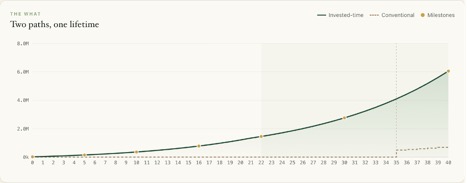
The model assumes 8 percent annual growth and reports future dollars. Write to me if you want to try the calculator.
That value belongs to the children, then their families, their communities, and the world. Entitlement costs every one of them.
Why this matters more now
Astro Teller drew a simple chart that Thomas Friedman made famous. Technology climbs on a steep curve. Human adaptability climbs on a gentle one. The lines have crossed, and we are standing just past the crossing.
Economists call the result a K-shaped economy. Moody’s estimates the top 10 percent of earners now account for close to half of all consumer spending. The Minneapolis Fed has pointed out that other data sets show a smaller gap, so the size of the K is still argued. The direction is not.
One caution, since data matters here. You have heard “shirtsleeves to shirtsleeves in three generations,” usually with a statistic attached: 70 percent of family wealth gone by the second generation. The studies behind that figure are vague. It appears to trace back to John Ward’s 1987 research on family companies, which found about 30 percent surviving the second generation and 13 percent the third.
That is a finding about businesses, not fortunes, and the saying grew out of the misreading. Families do rise and fall. Nothing in the data says they must.
Net capability, defined
Here is the definition I propose.
Net capability (NC) is a person’s or family’s capacity to turn every form of capital into a good life as conditions change, after accounting for the habits that wear that capacity down.
Ultra High Net Capability (UHNC) describes a person or family whose capability keeps growing across all five capitals, and survives a change of fortune in either direction.
The word capability has a distinguished history. Amartya Sen and Martha Nussbaum built the capability approach decades ago to argue that a country should be judged by what its people are able to do and be, not by its income. I am borrowing their idea and bringing it home, to the scale of one person and one family.
UHNC also sits between two frameworks I admire. Hughes describes the capital a family builds and then, ideally from a position of choice, decides what to optimize for. Sahil Bloom describes five types of wealth a person ends up feeling: time, social, mental, physical, and financial. Capability is the work in the middle. Capital goes in, capability converts it, and wealth in Bloom’s fuller sense comes out.
I know “ultra high” is a strange phrase for a man who writes about enough. I am keeping it on purpose. UHNC has no dollar threshold and no league table. The comparison to take seriously is your current self against your past self, and your family against its own last year.
How to calculate your NC
Net worth is assets minus liabilities. Net capability works the same way.
The clearest statement of those assets and liabilities I have seen comes from Tyson Kratz, co-founder of SolBe Learning in Brookline, Massachusetts. His framework for early education puts courageous, playful curiosity at the center, with four capacities around it. Each one has a shadow. I have paired his five with Hughes’s five capitals.
| Capital | Asset | Liability |
| Human | Curious | Guarded |
| Spiritual | Conscious | Lost |
| Intellectual | Competent | Stagnant |
| Social | Caring | Disconnected |
| Financial | Constructive | Misguided |
Try it as an exercise. Score each asset from 0 to 5. Score each liability from 0 to 5. Subtract. Your NC lands somewhere between negative 25 and positive 25.
Then do the part that matters. Ask someone who loves you to score you. The distance between your number and theirs is the finding.
George Box said it best: “All models are wrong, but some are useful.” This one is useful because it gives a family something to talk about other than the money.
Disclosure: I am a business partner of Solbe’s owners, and we are building Latticework together.
What net worth hides: the children of ambition
The strongest evidence that net worth is a poor guide, across generations, comes from the children of the people who have it.
In 2019 the National Academies of Sciences, Engineering, and Medicine added a new group to its list of at-risk youth. Alongside children in poverty, in foster care, and with incarcerated parents, it named students at high-achieving schools. A Robert Wood Johnson Foundation report the year before had listed “excessive pressure to excel” beside poverty, trauma, and discrimination.
The late Suniya Luthar spent more than twenty years on this. In a study published in 2002, she found clinically significant depressive symptoms in 14 percent of seventh-grade girls in one affluent suburb, twice the 7 percent national norm.
She named two causes. The first was achievement pressure. The second was isolation from adults, especially low felt closeness to mothers and empty houses after school.
I call that second cause unintentional neglect. Nobody chooses it. It is what a child experiences when the adults are busy winning, or trying to win through chaos and luck.
Twenty-eight hours
American adults now spend about four hours a day on their phones. That is 28 hours a week, a second part-time job that pays nothing. Teenagers are at a median of about four and a half hours, with 237 notifications a day. I wrote about where that attention goes in Broadcast: Seeds, Feeds, and Protecting Your Attention.
What does a small child see during those hours? Researchers at the University of Texas put recorders on infants and logged their mothers’ phone use for a week. Mothers spoke 16 percent less to their babies while on the phone. In short bursts of one or two minutes, the kind we do not even register, speech dropped 26 percent. It was a small study, 16 families, but it measured real life at home.
In a larger experiment with 227 parents and infants, babies showed the classic still-face response when a parent’s attention went to a phone. A Dutch team measuring brain activity in mothers and infants at the same moment found their synchrony fell during phone interruptions.
There is good news inside that last study. When the mother put the phone down, the synchrony came back.
That is the whole lesson in one finding. A child does not need a perfect record. A child needs to learn, over and over, one message: When we are together, you deserve my attention. We are safe to learn, to repair, to enjoy each other.
Children who never receive that message grow into adults who cannot give it. That is how a family’s human and social capital drains while the financial statement looks fine.
One curiosity, offered as a question. We can go years, even lifetimes, distracted by the next object, cheaper than ever, from the work on our four most critical capitals. The fifth weakens with them. The app that has taken the most of our children’s time was built in China, where the same company limits users under 14 to 40 minutes a day. Tick, tock, I hear in the name.
What we believe
When I say we, I mean me and the people I build with at Latticework, FatherForm, and Solbe.
- Start with enough. Heller’s word is where capability begins. You cannot give a child the feeling of being enough if you have never felt it yourself, so self-love comes first. Epictetus taught that peace begins with sorting what is ours to control from what is not. Larry Rosenberg, who teaches meditation a few miles from Solbe, built a whole book on the five facts that open this essay. Bloom writes it into his definition of financial wealth: you must name your own “enough.”
- Leave room to be wrong, at every age. In Corinna Luyken’s The Book of Mistakes, an ink blot becomes the best part of the drawing. Learning does not rise in a smooth line. It climbs, dips, and climbs again. A family or a company that punishes the dip never gets the climb. It is why I say fatherhood has no driving range.
- What works at four works at forty. The lessons Solbe teaches preschoolers are the lessons of adult flourishing: name what you feel, stay curious, repair after you rupture.
- Curious and humble is the base recipe. There is no perfect parenting and no perfect company. There are sound decisions at each stage that raise the odds. The habit underneath all of them is to ask more than you answer.
Net capability examples at every life phase
| Phase | What is being built | One practice | A failure to allow |
| 0 to 7 | Regulation, borrowed from calm adults | Phone in another room for the first 20 minutes home | Mess |
| 8 to 18 | Curiosity turning into passion | A running list of things they wonder about | Quitting something |
| 18 to 30 | A worldview of their own | One written page, dated, revised each year | A wrong first career |
| 30 to 50 | Carrying others | A family NC review every year | Saying “I was wrong” to your children |
| 50 to 70 | Stewardship | Hand over decisions before assets | A successor’s mistakes |
| 70 and up | Meaning | Letters and recorded reasoning | Unfinished business |
Tell people what the real goal is
Once you have a number, share it. Write one page and give it to the people who depend on you.
- Yourself: your worldview, in plain words
- Your family: the path you are on, and where failing is allowed
- Your company: what you are building toward besides revenue
- Your investments: which of the five capitals each dollar is meant to grow
We find the first of these in a two-day workshop called Visioneering. It is two days of chronos time, with a few loved ones or business associates, spent so that the rest of life runs closer to kairos time. The page you leave with is a baseline. There is plenty of room afterward to pivot, redirect, and grow.
Most families and most boards have never been told the actual goal. They guess, and they guess money.
Heir to our actions
The Buddha’s fifth fact says we inherit what we do. Heller said the same thing in one word at a party. Neither of them mentioned money.
A family with high net capability can lose a fortune, keep each other, and rise again. They can strengthen their foundations and stay curious. That is the wealth I want to be measured by, and the one I want my children to be heir to.
Next read: Rethinking Our Most Valuable Priorities, on measuring a family’s time the way we measure its portfolio.
Sources
- Upajjhatthana Sutta (Anguttara Nikaya 5.57), translated by Thanissaro Bhikkhu. https://dhammatalks.org/suttas/AN/AN5_57.html
- Morgan Housel, The Psychology of Money (2020), chapter 3, “Never Enough,” retelling the story from John C. Bogle, Enough: True Measures of Money, Business, and Life. Original: Kurt Vonnegut, “Joe Heller,” The New Yorker (2005).
- Anthropic’s Claude for Financial Advisors (September 14, 2026) and OpenAI’s ChatGPT for Financial Services the week before. https://www.investmentnews.com/goria/technology/anthropic-unveils-ria-focused-ai-suite-in-latest-claude-expansion/268180
- Altrata, World Ultra Wealth Report 2026. https://altrata.com/wp-content/uploads/2026/06/Altrata_World-Ultra-Wealth-Report-2026_FINAL.pdf
- Alan Watts, “Money Is Not Wealth,” from Does It Matter? Essays on Man’s Relation to Materiality. https://www.awakin.org/v2/read/view.php?tid=1022
- Cerulli Associates, U.S. High-Net-Worth and Ultra-High-Net-Worth Markets 2024. https://www.cerulli.com/press-releases/54-trillion-will-transfer-to-widows-through-2048-more-than-95-will-go-to-women
- James E. Hughes Jr. Family Foundation, Five Capitals. https://jehjf.org/wp-content/uploads/2023/06/Five-Capitals-One-Page-JEHJF.pdf
- Federal Reserve Bank of Minneapolis, “Have U.S. consumers gone K-shaped? A review of the data” (2026). https://minneapolisfed.org/article/2026/have-us-consumers-gone-k-shaped-a-review-of-the-data
- John L. Ward, Keeping the Family Business Healthy (1987), as summarized at https://resources.rework.com/libraries/family-business/shirtsleeves-to-shirtsleeves
- Sahil Bloom, The 5 Types of Wealth. https://the5typesofwealth.com/
- Tyson Kratz, “SolBe Big Picture” (internal deck, used with permission), including the Teller curve after Thomas Friedman’s Thank You for Being Late.
- National Academies, Vibrant and Healthy Kids (2019), as described by Suniya Luthar. https://www.psychologytoday.com/us/blog/privileged-but-pressured/202003/resilience-in-childhood-new-insights
- Luthar and Becker, “Privileged but Pressured? A Study of Affluent Youth,” Child Development (2002). https://pmc.ncbi.nlm.nih.gov/articles/PMC3524830
- Adult phone time: Consumer Reports coverage, May 2026, https://www.fox5vegas.com/2026/05/02/consumer-report-americans-check-phones-nearly-200-times-daily-survey-finds/ and Reviews.org, https://www.reviews.org/internet-service/internet-screen-time-statistics/
- Common Sense Media and University of Michigan, Constant Companion (2023). https://www.commonsensemedia.org/press-releases/teens-are-bombarded-with-hundreds-of-notifications-a-day
- Mikhelson et al., “Mothers speak less to infants during detected real-world phone use,” Child Development (2024). https://www.eurekalert.org/news-releases/1049072
- Stockdale et al., mobile phone modified still-face paradigm, Infancy (2020). https://zendy.io/title/10.1111/infa.12342
- van den Heuvel et al., “Maternal technoference decreases brain-to-brain synchrony during mother-infant interaction.” https://www.ncbi.nlm.nih.gov/pmc/articles/PMC12909859/
- Douyin’s 40-minute limit for users under 14 (September 2021). https://www.engadget.com/tik-tok-china-limits-kids-under-14-to-40-minutes-each-day-091559878.html
- Larry Rosenberg, Living in the Light of Death. https://www.shambhala.com/products/living-in-the-light-of-death-on-the-art-of-being-truly-alive
- Corinna Luyken, The Book of Mistakes. https://www.corinnaluyken.com/books/the-book-of-mistakes